


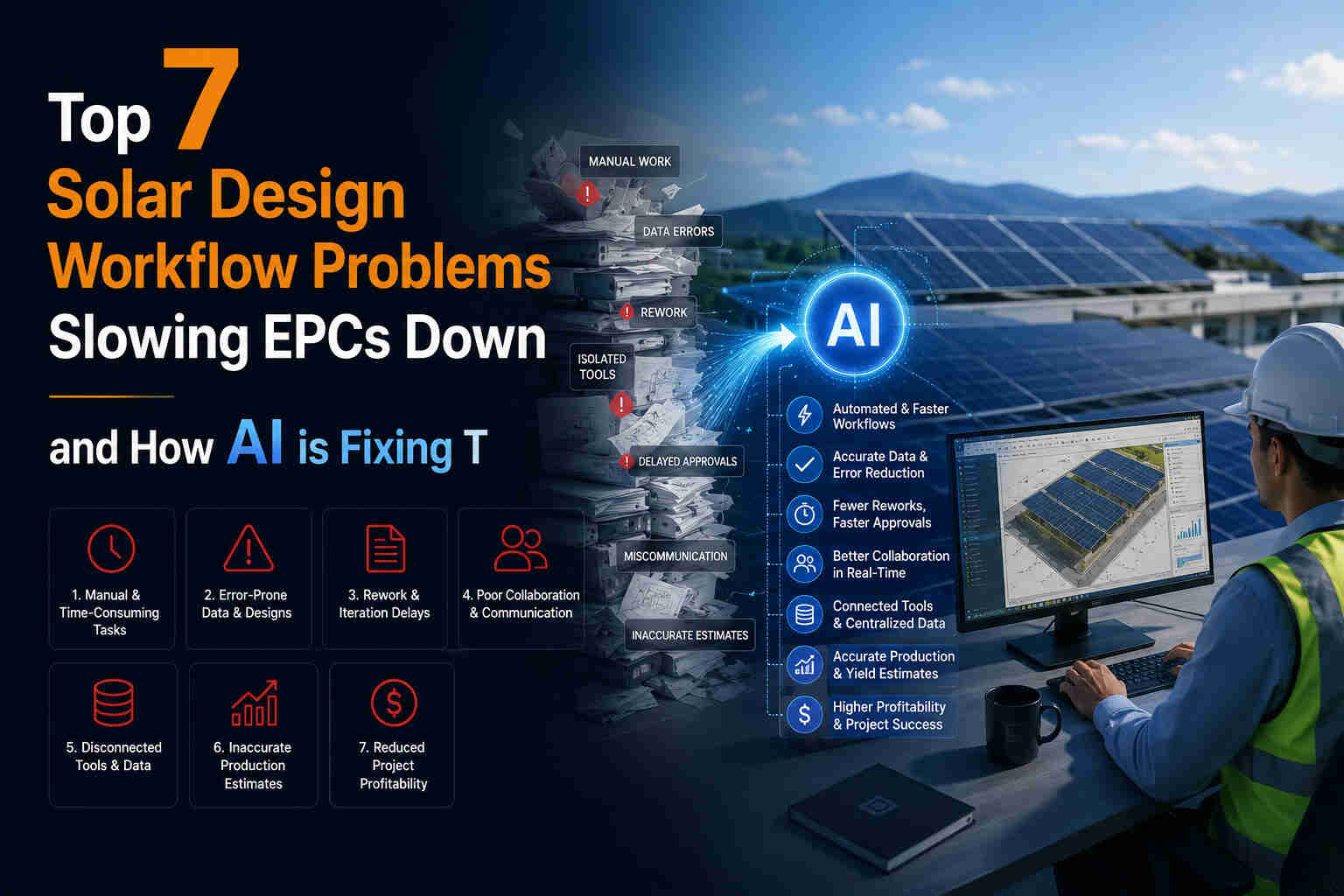
AI is a hot topic right now. Companies are realizing they cannot keep scaling with the same old processes. And this shift is not happening only in solar.
AI in solar design is becoming such a major shift across the industry. Companies are realizing they cannot keep scaling with the same old workflows and disconnected systems.
According to the National Renewable Energy Laboratory (NREL), generative AI can improve energy system efficiency and reliability through predictive planning and proactive operational support while also helping reduce operational costs.
In simple words, AI is helping energy companies work faster and smarter.
The biggest question is whether companies are using it properly or still losing valuable time on repetitive tasks that should have been automated long ago.
Let us break down the biggest workflow problems slowing EPCs down right now.

Ask almost any solar design team what takes too much time and site assessments will probably come up immediately.
Why? Because teams still spend hours tracing rooftops and checking obstructions and calculating shading losses manually before they can even start designing the system.
Now multiply that across dozens of projects every week.
It becomes a huge time drain very quickly.
And the frustrating part is that even after spending all that time, mistakes still happen. A missed obstruction or inaccurate shading estimate can throw off production calculations and create redesign requests later.
This is where AI in solar design is making a noticeable difference.
AI-powered platforms can now generate rooftop layouts automatically using satellite imagery and LIDAR-based mapping. They can detect roof obstacles and evaluate shading conditions much faster than traditional workflows.
One of the most searched questions online right now is Can AI design solar systems automatically?
Not completely. But it can absolutely remove a huge amount of repetitive assessment work that slows teams down every day.
And that alone saves EPC companies a massive amount of time.
.jpg)
Every EPC company knows how messy CAD revisions can get.
A customer asks for a layout change. Sales updates the request. Designers revise the drawing. Engineers recalculate the system. Then another change comes in and the whole cycle starts again.
The bigger the project pipeline gets, the worse this back and forth becomes.
This is exactly why solar design automation is becoming essential instead of optional.
AI-powered systems can automatically update layouts and recalculate system parameters whenever changes happen. Instead of manually rebuilding drawings every single time, engineers can work with workflows that adjust dynamically.
That means fewer repetitive revisions, faster approvals and less operational frustration overall.
AI is not replacing engineers. It is reducing the repetitive work that engineers never wanted to spend hours doing in the first place.
And for growing EPC companies, that difference matters a lot.
%20(1).png)

A lot of leads are lost simply because proposals take too long.
Customers today expect fast responses. If one installer takes three days to send a proposal and another responds in three hours, the faster company usually has the advantage immediately.
But many solar teams are still manually coordinating layouts and savings calculations and pricing details before proposals can even be created.
That delay hurts conversions.
This is where AI solar proposal tools are changing the game.
AI-assisted platforms can automatically generate proposals using design data and pricing information within minutes. Some systems can even personalize battery recommendations and savings visuals automatically.
According to McKinsey Digital, generative AI could improve productivity in operational functions by 20 to 45 percent through workflow automation and reduced manual effort.
That is a huge efficiency jump, especially for sales teams handling high lead volume.
Another question people constantly search is Can AI create solar proposals?
Yes. And honestly, it is becoming one of the fastest adopted use cases in solar software right now.

Engineering reviews slow down more projects than most people realize.
Teams need to verify roof load capacity and electrical compatibility and inverter sizing and code compliance before installations move forward. And when engineers are juggling multiple projects at once, these repetitive calculations start eating up a huge amount of time.
This is where AI solar software is quietly becoming extremely useful.
AI-powered systems can assist with equipment compatibility checks and electrical recommendations and automated calculations. That means engineers spend less time doing repetitive verification work and more time focusing on optimization and quality control.
Another thing people are wondering is Will AI replace solar engineers?
Probably not.
What AI will do is reduce repetitive technical work that slows engineering teams down every single day.
And honestly, most engineers would probably welcome that.

Permitting is probably one of the least enjoyable parts of solar operations.
Every jurisdiction has different requirements and utility rules and documentation standards. One missing detail can delay approvals for days or even weeks.
And when teams are handling multiple projects simultaneously, permitting quickly becomes administrative chaos.
This is where solar EPC automation is becoming incredibly valuable.
AI-powered systems can organize permit documentation automatically and identify missing information before submission. Some platforms can even standardize permit packages based on regional requirements.
That means fewer paperwork mistakes and fewer delays and a lot less manual follow-up work.
A very common question online right now is Can AI speed up solar permitting?
It definitely can help.
It may not eliminate approvals but it reduces a huge amount of avoidable administrative friction.
And for EPC companies, that saves both time and money.

This problem causes more delays than people expect.
Sales teams and designers and field crews often work across completely different systems. So when project details change not everyone gets updated immediately.
Installers sometimes show up on-site only to discover outdated layouts or unexpected changes that were never communicated properly.
That creates delays and customer frustration very quickly.
This is why companies are starting to use AI to automate solar design process workflows and improve internal coordination.
AI-powered systems centralize project communication and synchronize updates automatically between teams. When revisions happen, everyone sees the same updated information.
Simple idea. Huge operational impact.
Because honestly, many workflow problems in solar are not actually design problems.
There are communication problems.

A lot of EPC companies hit operational limits much earlier than expected.
Not because demand is low.
Because teams spend way too much time on repetitive admin work.
Updating spreadsheets and tracking approvals and organizing project files manually may work for smaller companies. But once project volume increases, those tasks become operational bottlenecks very quickly.
This is where AI in solar design and automation starts becoming impossible to ignore.
AI-powered systems can automate workflow tracking and project organization and document management while centralizing information across teams.
ARKA 360 integrates automation-driven workflows to simplify solar operations and reduce unnecessary manual coordination.
At some point, every growing EPC company reaches the same realization.
You cannot scale efficiently if your team is still spending hours every day managing repetitive admin work manually.
AI is improving solar workflows a lot but let us be realistic for a second.
It is not replacing human expertise anytime soon.
Complex engineering decisions and onsite troubleshooting and customer relationships still need experienced professionals. AI can speed up workflows and reduce repetitive tasks but it still needs human oversight.
And honestly, customers still want to talk to real people when discussing financing and installation expectations and solar project timelines.
The companies getting the best results from AI right now are not trying to replace teams.
They are using AI to remove operational headaches so their teams can focus on more valuable work.
That is where AI actually works best.
Q. 1 What is AI in solar design?
Ans. AI in solar design uses artificial intelligence to automate workflows like rooftop modeling and shading analysis, and proposal generation.
Q. 2 How is AI used in solar industry workflows?
Ans. AI is used for proposal generation and engineering support, workflow automation and project coordination.
Q. 3 Can AI create solar proposals automatically?
Ans. Yes, many AI solar proposal tools can automatically generate proposals using design data and pricing calculations within minutes.
Q. 4 Does solar design automation reduce project delays?
Ans. Yes, solar design automation helps reduce repetitive manual work and improves workflow speed across engineering, permitting and sales processes.
Q. 5 Will AI replace solar engineers?
Ans. No AI is mainly helping engineers reduce repetitive calculations and administrative work rather than replacing technical expertise.
Q. 6 Can AI help solar EPC companies scale faster?
Ans. Yes, AI-powered workflows help EPC companies manage larger project volumes more efficiently without adding excessive operational complexity.
.png)
Solar EPC companies are under pressure to move faster but many workflows are still slowing teams down every single day.
From site assessments and CAD revisions to solar proposal generation and permitting, the biggest problem is usually the same.
Too much manual work.
AI is helping fix that by reducing repetitive tasks, improving coordination and speeding up workflows across the entire project lifecycle.
The companies adopting automation early are not just improving efficiency. They are building operations that can actually scale without overwhelming their teams.

