



For many solar installers, the business starts simply.
A customer enquiry comes in. The details go into an Excel sheet. A salesperson follows up on WhatsApp. Site photographs are shared in a group. Someone prepares the solar design. Pricing is calculated on another spreadsheet. A proposal is created and sent to the customer.
When you are managing a handful of projects, this system can work.
But what happens when 10 leads become 50? When one salesperson becomes a team? When you are handling multiple site surveys, designs, proposals and follow-ups at the same time?
The tools that helped you start can quickly become the tools that slow you down.
For a growing solar installer or EPC, the question is no longer whether Excel and WhatsApp are useful. They are.
The question is whether they are enough to manage the entire solar sales process.
Increasingly, the answer is no.

But neither was designed to manage a solar business.
A typical solar sales process can involve:
And as the business grows, that fragmentation becomes increasingly difficult to manage.
Imagine receiving 30 new solar enquiries this week.
Some arrive through your website. Others come from digital advertising, referrals, channel partners, phone calls or walk-ins.
They are entered into a spreadsheet.
But who is following up with each lead?
When was the last call?
Did the customer ask for a 3 kW or 5 kW system?
Has the site survey been completed?
Was the proposal sent?
When should the salesperson call again?
A spreadsheet can record this information, but it doesn't necessarily create a structured sales process around it.
That's where solar lead management software becomes valuable.
With a dedicated solar CRM, every lead can have an owner, status, activity history and next action—giving the team greater visibility into where each opportunity stands.
.png)
WhatsApp has become an important communication channel for businesses, particularly in markets such as India.
Customers use it because it is quick and convenient.
But a WhatsApp chat isn't the same thing as a sales pipeline.
Important information can disappear inside hundreds of conversations:
"Please send the revised 5 kW quote."
"Can you call me next Monday?"
"I want to compare the EMI with the upfront payment option."
"Please add a battery option."
When these conversations aren't connected to a structured lead-management process, the salesperson has to remember what needs to happen next.
That may work with 10 prospects.
It becomes considerably harder with 100.
Solar is different from many other sales businesses because the proposal depends heavily on technical design.
Before a customer can make a decision, your team may need to understand:
Available rooftop area
Panel placement
System capacity
Shading
Module selection
Inverter configuration
Expected energy generation
Project cost
Customer savings
Payback period
If the salesperson works in one system, the designer in another and the proposal is prepared somewhere else, every handoff takes time.
The salesperson sends the site information to the designer.
The designer sends the system details back.
Someone updates the pricing spreadsheet.
Someone else creates the proposal.
Then the customer asks for a change.
And the process begins again.
This is exactly where an integrated solar design and proposal software platform can make a significant difference.
A good solar proposal does more than show a price.
It should help the customer understand what they are buying.
Depending on the project, a professional solar proposal may include the system design, system capacity, equipment specifications, expected generation, financial savings, payback calculations and visual representation of the proposed installation.
If your team is manually moving information between design software, Excel and presentation templates every time a proposal is created, you aren't just spending more time.
You're also creating more opportunities for inconsistencies and errors.
For a growing solar company, proposal creation needs to become a repeatable process.
Design the system. Calculate the economics. Create the proposal. Send it to the customer.
The fewer manual steps between those stages, the faster your team can respond.
As the business grows, the owner or sales manager needs answers to some very basic questions:
How many new leads came in?
How many have been contacted?
How many site surveys have been completed?
How many proposals are pending?
Which salesperson has the strongest pipeline?
Which opportunities need immediate follow-up?
How many deals are likely to close this month?
If answering these questions requires calling several people and combining multiple Excel sheets, the business has outgrown its sales-management process.
The goal of a CRM isn't simply to create another database.
It is to give your team one view of the customer and one view of the pipeline.
From Multiple Tools to One Solar Workflow
This is the problem ARKA360 is designed to solve.
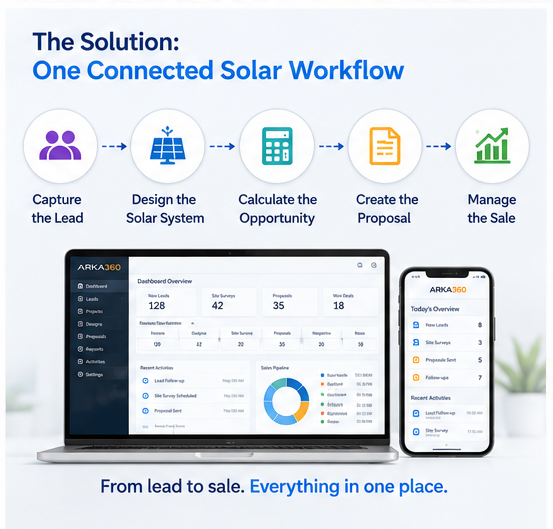
Rather than treating solar design, proposal creation and lead management as separate activities, ARKA360 brings them together into a connected solar sales workflow.
The journey becomes much simpler:
Add and organise customer enquiries in one place so that opportunities can be assigned, tracked and followed up systematically.
Create professional solar designs using tools built specifically for solar projects, including 3D modelling, panel placement and system analysis.
Bring system performance, project economics and customer savings into the sales conversation.
Turn the system design and project information into a professional, customer-ready solar proposal without rebuilding everything manually.
Track opportunities, activities and follow-ups as the customer moves through the sales pipeline.
Instead of having the customer in one spreadsheet, the conversation on WhatsApp, the design in another application and the proposal in another file, your team has a more connected workflow.
The biggest benefit isn't simply "going digital."
Most solar businesses are already digital.
The real advantage is connecting the different parts of the business.
When your lead management, solar design and proposal process work together, your team can spend less time searching for information, transferring data and checking spreadsheets.
Salespeople can focus on customers.
Designers can focus on accurate systems.
Managers can focus on the pipeline.
And customers can receive proposals faster.
That becomes increasingly important as your solar business scales.
This isn't only an enterprise problem.
In fact, smaller solar installers may benefit even more from improving their processes early.
When you have a small team, every hour matters.
The salesperson may also be the person conducting the site visit. The business owner may be reviewing proposals. A designer may be working across multiple projects simultaneously.
Using separate tools for every activity adds administrative work to a team that is already stretched.
A purpose-built solar installer software platform can help a smaller installer operate with the processes and professionalism of a much larger solar company—without necessarily building a large back-office team.
There is another change happening in the solar industry.
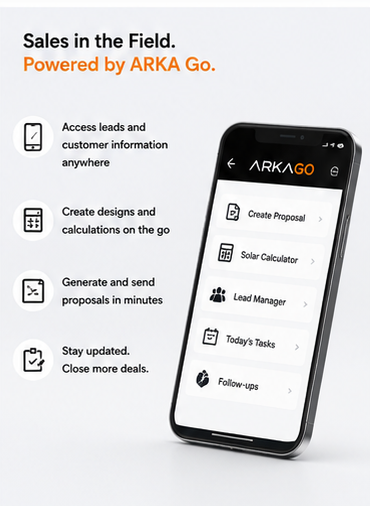
More of the sales process is moving into the field.
Installers and sales teams are meeting customers at homes, businesses and project sites. They need access to customer information, solar calculations and proposals without always returning to the office.
That's why the ARKA ecosystem is also extending to ARKA Go, bringing key solar sales capabilities to installers on the move.
The objective is simple:
Make it easier to move from customer enquiry to solar proposal wherever the sales conversation happens.
You don't necessarily need to stop using Excel.
And you certainly don't need to stop communicating with customers through WhatsApp.
Both will continue to have a role.
But they shouldn't have to run your solar business.
If your team is spending too much time updating spreadsheets, searching through conversations, transferring project information between applications or manually creating proposals, it may be time to rethink the workflow.
Ask yourself:
Can I see every active solar lead in one place?
Does every lead have a clear next action?
Can I quickly see which proposals are pending?
Can my sales and design teams work from the same customer information?
Can we move from design to proposal without repeatedly entering the same data?
Can I see my sales pipeline without asking the team for an updated spreadsheet?
Can my team respond to customers quickly when they are in the field?
If several of those answers are no, the problem may not be your team.
It may simply be that your business has outgrown the tools you started with.
Growing a solar business isn't just about generating more leads.
It's about building a process capable of handling those leads efficiently.
The companies that scale successfully will increasingly be the ones that connect their customer acquisition, sales, solar design and proposal processes rather than managing them as separate activities.
That's the idea behind ARKA360.
Design solar systems, create professional proposals, manage leads and build a more connected solar sales process with ARKA360.
Ready to see what a connected solar workflow could look like for your business?
Book a Free ARKA360 Demo.
.png)

