


You need a way to capture leads. A CRM to track prospects. Software to design solar systems. Spreadsheets to calculate pricing. Another tool to create proposals. WhatsApp and email for customer communication. Project management tools to coordinate the team.
Individually, each tool may work perfectly well.
The problem begins when none of them work together.
For a small solar installer managing a limited number of projects, switching between different platforms may seem manageable. But as leads increase, the sales team grows and projects become more complex, the cracks begin to show.
Information gets duplicated. Follow-ups get missed. Designs and proposals take longer. Salespeople spend more time looking for information. Management struggles to get a clear view of the pipeline.
The monthly software subscriptions are visible.
The hidden cost of disconnected tools isn't.
And for a growing solar installation business, that hidden cost can be far greater than the price of the software itself.
How Many Tools Does It Take to Close One Solar Customer?
Consider a typical residential solar sale.
A lead arrives through your website or digital campaign.
The customer details are entered into a CRM or spreadsheet.
The salesperson contacts the customer through WhatsApp.
Site photographs and measurements are stored somewhere else.
The project goes to a designer using specialist solar design software.
Pricing is calculated in Excel.
A proposal is created in PowerPoint, Word, Canva or another proposal platform.
The PDF is emailed or WhatsApped to the customer.
The salesperson then returns to the CRM—or perhaps another spreadsheet—to update the lead.
The customer asks:
“What happens if I increase the system from 3 kW to 5 kW?”
Now several parts of the process may need to be repeated.
This is where the hidden cost begins.
Customer name.
Address.
Electricity consumption.
Roof details.
System size.
Module specifications.
Pricing.
Contact information.
When different teams work on different applications, the same information often has to be entered more than once.
That creates two problems.
First, it takes time.
Second, every time information is manually transferred, there is an opportunity for error.
A 5 kW system becomes 4.5 kW in the proposal. An old module price remains in a spreadsheet. A revised design isn't reflected in the final quotation.
None of these errors are caused by a lack of effort.
They're often simply the result of too many disconnected steps.
.png)
Think about a salesperson's working day.
How much of it is actually spent talking to customers?
And how much is spent:
• Updating spreadsheets
• Searching WhatsApp conversations
• Finding site photographs
• Asking designers for updates
• Checking proposal status
• Copying customer information
• Creating quotations
• Updating the CRM
• Searching for the latest version of a file
Each activity may take only a few minutes.
But across 20, 30 or 50 active opportunities, those minutes add up.
Your most expensive sales resource can gradually become an administrator.
For a growing solar installer, this is one of the most significant hidden costs of using too many tools.
Solar customers rarely evaluate just one installer.
They may speak to several companies, compare system capacities, brands, prices, savings and financing options before making a decision.
That makes response time important.
Imagine two installers visit the same customer.
Installer A takes two days to coordinate the design, calculate the price and prepare the proposal.
Installer B can move from site information to system design to a professional proposal much faster.
Who controls the conversation?
Speed doesn't guarantee the sale.
But delays can certainly make it harder to win one.
The more systems your team has to move between, the longer the journey from customer enquiry to customer proposal can become.
The CRM says one thing.
WhatsApp contains another conversation.
The designer has the latest rooftop layout.
Finance has revised the price.
And the salesperson has notes on their phone.
So where is the definitive customer record?
This becomes particularly problematic when another employee needs to take over the account.
They may know that a proposal has been sent—but not that the customer requested a battery option yesterday.
They may see the original 3 kW proposal—but not realise that the design team has already revised it to 5 kW.
A growing solar business needs more than data.
It needs connected data.
Most solar customers don't buy after the first conversation.
They need follow-ups.
Some are waiting for financing.
Some want to discuss the proposal with their family.
Some are comparing another quotation.
Some ask you to call after payday.
Some want to wait a month.
The opportunity may still be very real.
But if follow-ups are scattered across personal reminders, spreadsheets and WhatsApp conversations, prospects can easily disappear from view.
That's not just a productivity issue.
It's lost revenue.
A structured solar CRM and lead management system helps turn follow-up from something salespeople need to remember into part of the sales process.
As a solar company grows, management needs visibility.
Not another spreadsheet.
You need to know:
• How many active leads do we have?
• How many are qualified?
• How many designs are pending?
• How many proposals have been sent?
• Which leads haven't been contacted recently?
• Which salesperson has the strongest pipeline?
• Which opportunities are most likely to close?
When different parts of the customer journey sit in different applications, answering simple business questions can become surprisingly difficult.
Managers end up asking teams to create reports.
Salespeople update spreadsheets.
Different numbers appear in different places.
By the time the report is ready, the pipeline may already have changed.
There's an understandable tendency for growing businesses to solve each new problem by adding another application.
Need lead management?
Buy a CRM.
Need solar design?
Add solar design software.
Need proposals?
Add a proposal tool.
Need field sales?
Add another app.
Need reporting?
Connect a dashboard.
Soon the business has built a technology stack containing multiple subscriptions, multiple logins and multiple databases.
The question shouldn't be:
“How many tools do we have?”
It should be:
“How smoothly can a customer move through our business?”
The Better Question: Can Your Solar Workflow Connect?
For a solar installer, the ideal customer journey is relatively straightforward:

Technology should make that journey faster.
It shouldn't create additional handoffs between each stage.
This is where the ARKA360 approach is different.
ARKA360: One Connected Solar Sales Workflow
ARKA360 is designed specifically around the way solar businesses sell.
Rather than treating solar CRM, solar design and solar proposal software as completely separate activities, ARKA360 brings key parts of the journey together in one solar platform.
A customer can move through a more connected workflow:
Organise customer enquiries, assign opportunities and maintain visibility over the sales pipeline.
Create professional solar designs with tools built specifically for solar projects, including 3D modelling, panel placement and system analysis.
Translate technical design into information the customer can understand—system performance, generation, savings and financial outcomes.
Bring design and project information into a customer-ready proposal without rebuilding the project manually across multiple tools.
Keep track of the customer as the opportunity moves from enquiry to proposal, follow-up and closure.
The objective isn't simply to replace software.
It's to remove friction between the different stages of the solar sale.
One Platform Can Mean Fewer Handoffs
Consider the difference.
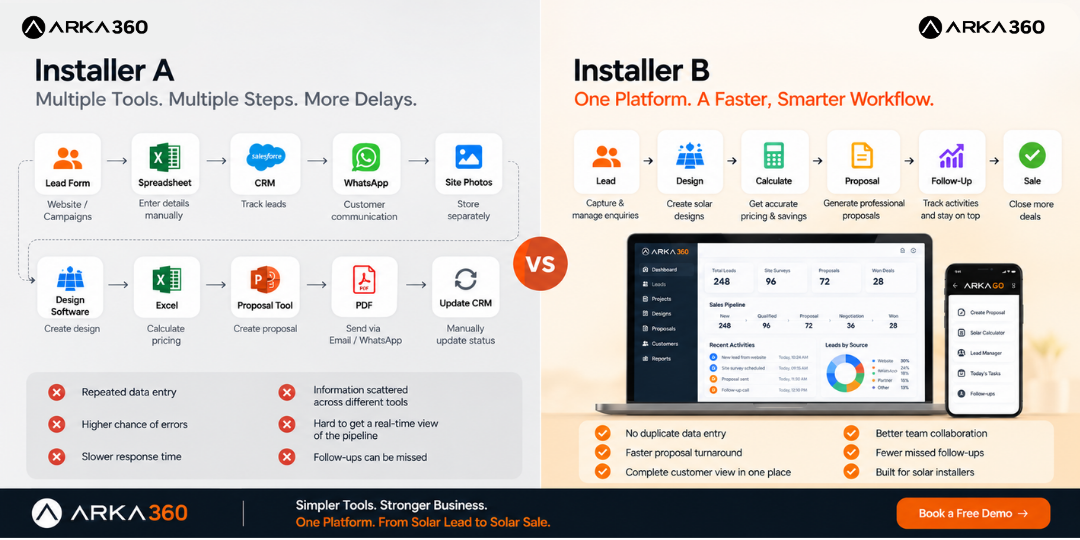
A Fragmented Solar Sales Process
Lead Form → Spreadsheet → CRM → WhatsApp → Site Photos → Design Software → Excel → Proposal Tool → PDF → WhatsApp → CRM
Every arrow represents another handoff.
Another opportunity for delay.
Another opportunity for information to be lost.
Now consider:
A Connected Solar Sales Process
Lead → Design → Calculate → Proposal → Follow-Up → Sale
That is the principle behind ARKA360.
One platform. From solar lead to solar sale.
What Does This Mean for a Growing Solar Installer?
The benefits go beyond software convenience.
• Respond to leads faster
• Reduce repetitive data entry
• Improve collaboration between sales and design teams
• Create proposals more efficiently
• Maintain better visibility over follow-ups
• Standardise your sales process
• Give management a clearer view of the pipeline
• Create a more professional customer experience
Most importantly, it can help your team spend more time on the activities that actually grow the business.
Designing better systems. Talking to customers. Sending proposals. Following up. Closing sales.
What About Teams Working in the Field?
Solar sales doesn't happen only in an office.
Your team may be meeting homeowners, visiting rooftops, surveying commercial sites or travelling between projects.
That makes mobile access increasingly important.
The ARKA ecosystem extends this connected approach through ARKA Go, designed to help solar professionals access important sales capabilities while they're on the move.
For installers, the opportunity is to reduce the gap between:
Site Visit → Customer Conversation → Solar Proposal → Follow-Up
The closer those activities can happen to the actual customer interaction, the less momentum is lost.
Are You Using Too Many Tools?
There's no ideal number of applications for every solar company.
But there are some useful warning signs.
Ask yourself:
• Does our team enter the same customer information more than once?
• Are leads managed in multiple spreadsheets?
• Are important customer conversations sitting only in individual WhatsApp accounts?
• Does the sales team regularly ask the design team for project status?
• Do we manually transfer design information into proposals?
• Are there multiple versions of the same customer quotation?
• Do managers need spreadsheets to understand the current sales pipeline?
• Are follow-ups occasionally missed?
• Does creating a proposal take longer than it should?
• Are we paying for several platforms that solve different pieces of the same sales journey?
If you answered yes to several of these questions, your business may not need another tool.
It may need fewer disconnected tools and a better-connected workflow.
Don't Just Add More Software. Build a Better Solar Sales Process.
As the solar industry grows, technology will become increasingly important to installers and EPCs.
But digital transformation isn't about having the most applications.
It's about removing unnecessary steps between a customer saying:
“I'm interested in solar.”
and
“Let's go ahead.”
For a growing solar installer, every unnecessary handoff adds time.
Every disconnected database adds complexity.
Every missed follow-up carries a potential cost.
And every hour your team spends managing software is an hour they aren't spending with customers.
ARKA360 brings solar lead management, design, proposals and sales workflows closer together—helping solar businesses build a process designed to scale.
One Platform. From Solar Lead to Solar Sale.
.png)

